Chapter 3 · 2018–2021
Ruin and Restoration
By 2018 (8 years ago) the house was a roofless ruin. Within three years it was standing again.
Decline
For most of the 20th century the house was a family home. Ruqayya al-Ghussein, the builder’s granddaughter, lived there from her birth in 1923 (103 years ago) until her death in 2018, a span of 95 years. She opened it as a gathering place for the women of old Al-Daraj.[4, 6]
Damp, cracking and age took their toll, as they have on many of Gaza’s historic buildings, some of which go back to the Mamluk era of the 13th century (about 776 years ago). In a region strained by blockade and repeated crises, there was little money or expertise to save them.[1, 6] When a team from the Goethe-Institut visited with Iwan’s engineers in 2018, the house was “a ruin without a roof, whose original beauty could only be guessed at.”[1]
A partnership to rebuild
Early in 2020 (6 years ago), the Iwan Center for Architectural Heritage at the Islamic University of Gaza began a study of how to save the building. The owner signed a cooperation agreement but died soon afterward, and her heirs kept the agreement in force.[3]
In July 2020 restoration began. The Goethe-Institut Palestinian Territories led the project with two local partners: Riwaq – Centre for Architectural Conservation in Ramallah and Iwan in Gaza. Funding came from the German Federal Foreign Office’s Cultural Preservation Programme, a grant of €55,992.[1, 2]
- Started
- July 20206 years ago
- Led by
- Goethe-Institutwith Riwaq & Iwan
- Funded by
- German Foreign Office€55,992
- Built by
- Brand Companysupervised by Iwan
Brand Company for Contraction and General Trading did the building work under Iwan’s supervision. The work continued through the pandemic and through shortages of materials under the blockade. Along the way, Iwan and Riwaq trained a group of local engineers on site in traditional restoration techniques.[1, 2, 4]
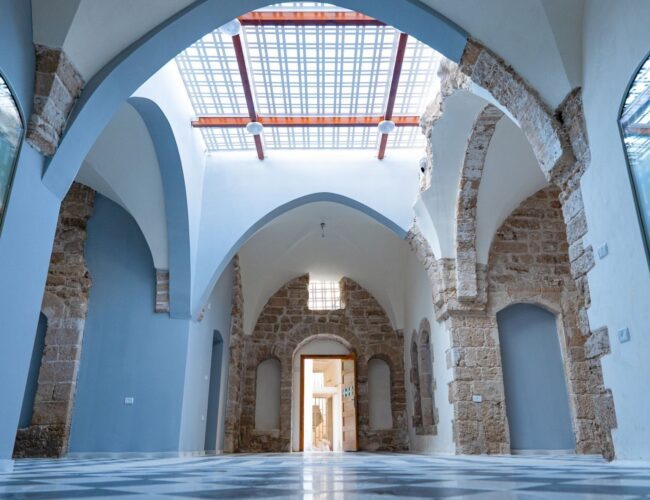
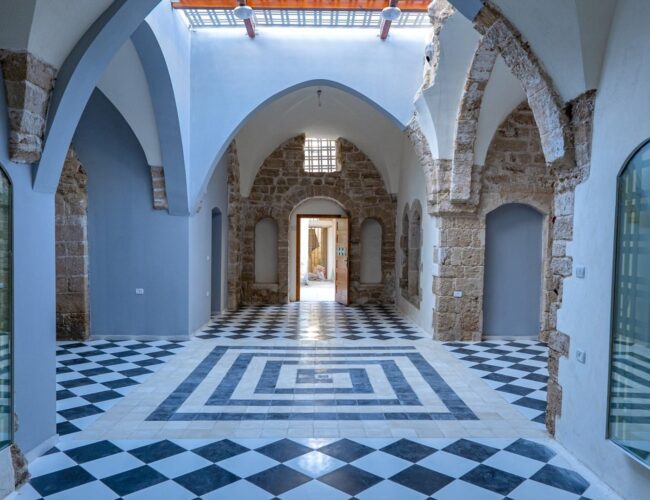
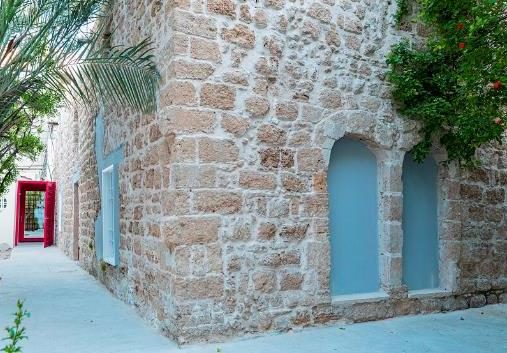
The aim, in the Goethe-Institut’s words, was to bring back the house’s “picturesque beauty and architectural uniqueness, to harmonize old and new techniques and materials, and to make the traces of the house’s past visible.”[1] A new glass skylight now lit the central hall, and a blue-and-white geometric floor was laid beneath it. Wherever possible, the original stone was left exposed.
Through the bombing of May 2021
In May 2021 (5 years ago), just weeks before the house reopened, Gaza was heavily bombed. The house came through undamaged, as it had come through earlier conflicts.[1]
You can see the finished house in the Goethe-Institut’s short film below.
“The final shape of Al-Ghussein house,” Goethe-Institut Ramallah.